1. EFICCID (ICC Identification) –
3F00/2FE2
This EF provides a unique identification number for the SIM.
 |
| EFICCID structure |
Identification Number Coding:
BCD, left justified and padded with 'F'; after padding the digits within a byte are swapped (see below).
However, network operators who are already issuing Phase 1 SIM cards where the digits within a byte are
not swapped may retain this configuration.
 |
| ICCID coding |
2. EFIMSI (IMSI) – 3F00/7F20/6F07
This EF contains the International Mobile Subscriber Identity (IMSI).
 |
| EFIMSI structure |
- length of IMSI:
The length indicator refers to the number of significant bytes, not including this length byte, required for the IMSI.
- IMSI coding:
This information element is of variable length. If a network operator chooses an IMSI of less than 15
digits, unused nibbles shall be set to 'F'.
*Parity Bit:
1 - Odd Number of identity digits.
0 - Even Number of identity digits.
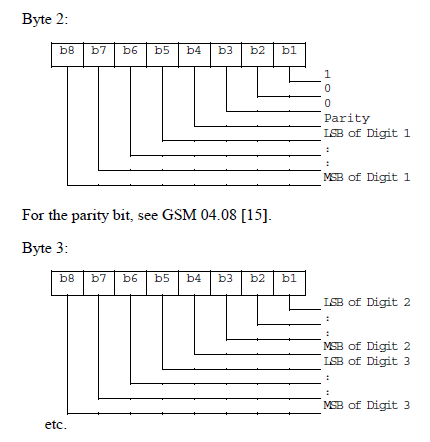 |
| IMSI coding |
 |
| IMSI Structure |
3. EFAD (Administrative data) - 3F00/7F20/6FAD
This EF contains information concerning the
mode of operation according to the type of SIM, an indication of whether some ME features should be activated during normal operation as well as
information about the length of the MNC, which is part of the International Mobile Subscriber Identity (IMSI).
 |
| EFAD structure |
- MS operation mode
Contents: mode of operation for the MS (Mobile Station)
Coding:
Initial value
- normal operation '00'
- type approval operations '80'
- normal operation + specific facilities '01'
- type approval operations + specific facilities '81'
- maintenance (off line) '02'
- cell test operation '04'
- Length of MNC in the IMSI :
Contents:
The length indicator refers to the number of digits, used for extracting the MNC from the IMSI
 |
| IMSI length coding |
4. EFPLMNsel (PLMN selector) - 3F00/7F20/6F30
This EF contains the coding for n PLMNs, where n is at least eight. This information determined by the user/operator defines the preferred PLMNs of the user in prority order.
 |
| EFPLMNsel structure |
- PLMN
Contents:
Mobile Country Code (MCC) followed by the Mobile Network Code (MNC).
MCC: 3 digits.
MNC: choice of 2 or 3 digits. (depends on length indicate in EFAD).
Coding:
according to GSM 04.08 [15].
If storage for fewer than the maximum possible number n is required, the excess bytes shall be set to 'FF'.
Diagrams below illustrate
how to swap the MCC and MNC and store it in the file:
EXAMPLE:
a.
using 246 for the MCC and 81 for the MNC and if this is the first and only PLMN, the
contents reads as follows:
Bytes 1-3: '
42' 'F6' '18'
Bytes 4-6: 'FF' 'FF' 'FF'
etc.
b.
using 246 for the MCC and 810 for the MNC and if this is the first and only PLMN, the
contents reads as follows:
Bytes 1-3: '
42' '06' '18'
Bytes 4-6: 'FF' 'FF' 'FF'
etc.
The following link record the MCC and MNC for worldwide operator:
http://en.wikipedia.org/wiki/Mobile_Network_Code
* MCC, and MNC of the following files is convert this way too:
a. EFFPLMN (Forbidden PLMNs) - 6F7B
b. EFCNL - 6F32
c. EFPLMNwACT (PLMN Selector with Access Technology) - 6F60
d. EFOPLMNwACT (Operator controlled PLMN Selector with Access
Technology) -6F61
e. EFSLL (SoLSA LSA List) - 4F31
f. EFLOCI (Location information) - 6F7E(INSIDE LAI)
5. EFLOCI (Location information) - 3F00/7F20/6F7E
This EF contains the following Location Information:
- Temporary Mobile Subscriber Identity (TMSI);
- Location Area Information (LAI);
- TMSITIME;
- Location update status.
* This file is update after user log in to network.
 |
| EFLOCI structure |
TMSI
: Temporary Mobile Subscriber Identity
LAI coding is shown in Figure 10.4 , Figure 10.5.3 above. (PLMN+LAC-Local Area code)
TMSI TIME: Current value of Periodic Location Updating Timer (T3212). This byte is used by Phase 1 MEs, but it shall
not be used by Phase 2 MEs.
Location update status:
Byte 11:
Bits: b3 b2 b1
0 0 0 : updated
0 0 1 : notupdated
0 1 0 : PLMNnotallowed
0 1 1 : Location Area not allowed
1 1 1 : reserved
Bits b4 to b8 are RFU (set to 0).


