Showing posts with label GlobalPlatform. Show all posts

Monday, 28 May 2012

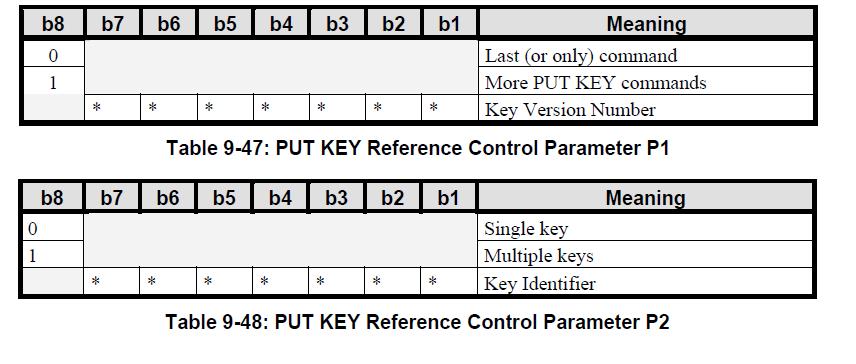
PUT KEY command: way to encrypt key data value and get key check value for SCP 02


Key Encryption and Decryption (Card Specification v 2.0.1)

Key encryption is used when transmitting key data to the card and is over and beyond the security level required for the Secure Channel i.e. all DES keys transmitted to a card (PUT KEY command) should be encrypted.

The key encryption process uses the static Key Encryption Key(KEK/DEK) and the encryption method described in section 12.1.3. (ECB mode) As all DES keys are by their very nature a multiple of 8-byte lengths no padding is required for key encryption operations.

The encryption is performed across the key data and the result of each encryption becomes part of the encrypted key data. This encrypted key data becomes part of the clear text data field in the command message.

The on-card decryption of key data, is the exact opposite of the above operation.

Key verification  (Card Specification v 2.0.1)

In order to verify that the card received the correct key, each DES key transmitted to the card in the PUT KEY command has an associated key check value.

The check value generation process uses the clear text key using the encryption method described in section 12.1.3. The data to be encrypted is binary zeroes and as it is defined to be 8 bytes, no padding is required. The encryption is performed across the 8 binary zeroes and only the 3 right most bytes of the result are required as a check value. As with the encrypted keys the check value becomes part of the clear text data field in the command message.

Following the decryption of the keys, on-card verification of the key is achieved by performing the exact same operation as defined above and comparing the 3 right most bytes of the encryption with the check value in the data field.


Log: 

00A4040007A0000001510000SW6111
00C0000011SW6F0F8407A0000001510000A5049F6501FF9000
8050000008BD4E6A713DD7D805SW611C
00C000001CSW00000000000000000000FF0200010C6892C3B73CFE58E93B5ECF185E9000
8482000010B88BB23C01C42F1A49D2357B41AC2E93SW9000
80D8000117218010D09780F8AB1875477824E706C2E208BB0320309BSW9000
00C0000004SW2120309B9000

Way to encrypt key data value and get Key Check Value (SCP 02)

1. get static key(KEK): 

derivation data: 01810001000000000000000000000000
KEK key(DEK):  505152535455565758595A5B5C5D5E5F
//CBC DES:
static key: 8D2FA346ED9E2A4E15E100B07328E7A2

2. get enc data value: 

data value: 404142434445464748494a4b4c4d4e4d (This will be the new key you want to add/change)
static key: 8D2FA346ED9E2A4E15E100B07328E7A2
//ECB DES:
ENCdata: D09780F8AB1875477824E706C2E208BB

3. get check value: 

data value: 0000000000000000
key:  404142434445464748494a4b4c4d4e4d (This will be the new key you want to add/change)
//ECB DES  & get first three bytes.  20309B5AEC51125E:
Key Check Value:  20309B

4. Organise PUT KEY command.

//80D8000117218010+ENCdata+KeyCheckValueLength+KeyCheckValue
80D8000117218010D09780F8AB1875477824E706C2E208BB0320309BSW9000
00C0000004SW2120309B9000

PUT KEY command structure


Thursday, 17 May 2012

Explicit Secure Channel Initiation: Way to calculate authentication cryptogram and CMAC for SCP 02

for details, please refer to GlobalPlatform Card Specification 2.2 - Annex E

A. Brief Introduction 


Usage: 

Explicit Secure Channel initiation allows the off-card entity to instruct the card (EXTERNAL AUTHENTICATE COMMAND) as to what level of security is required for the current Secure Channel and apply this level of security to all the subsequent messages exchanged between the card and the off-card entity until the end of the session.

Flow: 

Figure 1: Explicit Secure Channel initiation Flow

B. Commands Structure

B.1 INITIALIZE UPDATE

Table 1: INITIALIZE UPDATE command structure
Key Version Number: defines Key Version Number within the Secure Domain (SD) to be used to initiate the Secure Channel Session. If this value = 0x00, the first available key chosen by SD will be used.

Host challenge: randomly generated number

Response Message:
Table 2: INITIALIZE UPDATE command Response Message

B.2 EXTERNAL AUTHENTICATE 

Table 3: EXTERNAL AUTHENTICATE command structure
Host cryptogram: 8 bytes 
MAC: 8 bytes
Security Level: 
Table 4: Security Level coding

C. Way to calculate authentication cryptogram and CMAC

Way to calculate Host authentication cryptogram and CMAC will be illustrated by example below: 

8050000008659CFAB838A36C9E SW611C
00C000001CSW00000000000000000000FF02000092F744482D1E 26A365DF89B1EAEA9000
8482000010448126B770B27702D770D0A0001B05AASW9000


1. Generate Session Key 

Figure 2: Session Key generation diagram
*constant for C-MAC: '0101'
  constant for R-MAC: '0102'
  constant for S-ENC: '0182'
  constant for DEK: '0181'
*Sequence counter - get it from response of INITIALIZE UPDATE command. refer to Table 2.
*CBC encryption: Triple DES in CBC mode, ICV: 0000000000000000


base key used(Depends on your implementation.Not a fixed value): 
ENC: 30313233435363738393A3B3C3D3E3F
MAC: 404142434445464748494A4B4C4D4E4F
DEK: 505152535455565758595A5B5C5D5E5F


a. generate S-ENC: 
Derivation data: 01820000000000000000000000000000
S-ENC: 8D04904F18B948EEB78A1972B9527E71

b. generate S-MAC: 
Derivation data: 01010000000000000000000000000000
S-MAC: D1C28C601652A4770D67AD82D2D2E1C4

2. Calculate Host Authentication Cryptogram


a. Concatenated data: Sequence Counter+Card Challenge+Host Challenge
    Concatenated data: 000092F744482D1E659CFAB838A36C9E

b. Apply DES padding: 
    - Append an '80' to the right of the data block;
    - If resultant data block is a multiple of 8 bytes, no further padding is required;
    - Append binary zeroes to the right of the data block until the data block length is a multiple of 8 bytes.
    * If data is being padded with the intention of generating a MAC, the padding is discarded following the            DES operation. 
   Padding data: 000092F744482D1E659CFAB838A36C9E8000000000000000

c.  Generate authentication cryptogram by using signature method. 
    Signature method: Full Triple DES, more specified: Triple DES in CBC mode, ICV: 0000000000000000
    Since K = K', Algorithm 3 is downgrade to Algorithm 1. So it is TDES in CBC mode.
    After encrypt: B84449ADC4325C5BF9366187E977797D448126B770B27702
    Host cryptogram will be the last 8 bytes.
    Host cryptogram: 448126B770B27702
 *Way to calculate Card authentication cryptogram is same as above. The only different is the concatenated data. Concatenated data: Host Challenge+Sequence Counter+Card Challenge.

3. Calculate C-MAC

a. Organise your APDU command: 8482000010448126B770B27702
b. Padded data: 8482000010448126B770B27702800000
c. C-MAC generation use Single DES Plus Final Triple DES (so called Retail MAC). Refer to Figure 3 below:
Key 1: D1C28C601652A477
Key 2: 0D67AD82D2D2E1C4
Retail MAC diagram
   Calculated CMAC: D770D0A0001B05AA